
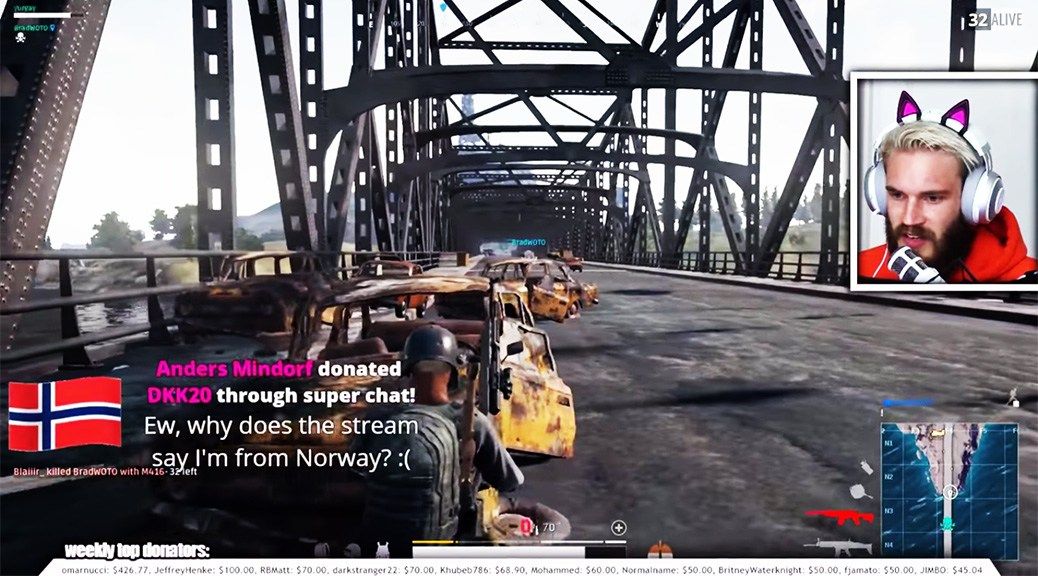
Felix “PewDiePie” Kjellberg recently said the “n-word” on a stream of the popular online shooter Playunknown’s Battlegrounds.1 For those who follow Kjellberg’s “antics”, this is no surprise; earlier this year, he paid two men in India to record themselves holding up a sign that said “DEATH TO ALL JEWS”. In a half-hearted apology, he placed a lot of the blame on the Wall Street Journal for taking his “joke” out of context. 2 Unfortunately, this is far more representative of video game culture than we’d like to admit.
Kjellberg aside, online video games have festered with unpoliced hate speech ever since ther inception. Because Maze Rats is a fan of video games and a strong opponent of hate speech—in all its forms—we are presenting a three part series that looks at how hate speech is weaponized in video games, how it becomes normalized in online communities, and how disparate groups have intersected, ultimately leading to the rise of the alt-right.
At the bottom of each article, we are going to highlight an online community that pushes back against hate speech and creates a welcoming, mindful environment.
Hate Speech in Video Games
Because of the competitive nature of online video games, it becomes common practice to “smack talk” as a way to psychologically affect the other player. If you can piss off the enemy, then they won’t play as well. When someone is bad at smack talk, it’s easy to revert to saying whatever is most likely to piss them off. These tend to be sexist, homophobic, and racist slurs. After all, if it’s inappropriate in the real world, it’s probably going to be bad online, too.
A study in 2010 at UNC Chapel Hill found that people admitted to being more accepting of hate speech when used in a video game environment than in other contexts.3 Part of the reason hypothesized by the report is that games “fragment” users’ interactions with each other. While pseudonymous and anonymous message boards help to hide a person’s identity, video games have several moments in which the player’s interaction with other players is paused or ended. For example, when a map is loading and the player is sitting at a loading screen, they are generally not interacting with other players. Another example is when a player is navigating menus. Some games actually create interactivity during these breaks. The study argues that this distance makes the interactions feel less “real”, and therefore nurtures antisocial behavior.
The same team conducted another study where they surveyed actual gamers through Xbox Live voice chat. 4 Most of the interviewees “focused on the idea that anonymous gamers can say anything they like and face no consequences.” Aside from that, more competitive game modes were more likely to spark hate speech than cooperative game modes. As I mentioned previously, the competitive nature sparks aggressive speech, particularly hateful slurs. According to the study, “Most gamers thought hate speech was a way for people to distract opponents and get a competitive advantage.” A player named Johnnykom82 said, “Like in a sporting event, teams talk trash to each other.” DebatingBeeftek said hate speech is “a way to just piss another person off and get them distracted thinking about the comment instead of the game.”
Based on the current research, these sexist, homophobic, and racist slurs are generally used in online games to insult the enemy and get them “off their game”. What’s interesting is that Kjellberg’s slur was not used in this way because he had no voice chat connection to the enemy. What Kjellberg demonstrated was that hate speech is used for more reasons than just competitive intimidation.
I want to stress that I am not trying to “explain” hate speech as a way to “excuse” it. On the contrary: I want people to realize just how harmful it is, and how becoming “normal” is actually hurting the world around us. So keep in mind that, when looking at hate speech, it’s important to look at how people use it because, as we’ll see in the upcoming weeks, it’s not always used by the same people or for the same reasons.
In next week’s article, we’re going to take a look at how hate speech is used by online communities, particularly anonymous message boards like 4chan. Be forewarned: things are going to get a lot darker and a lot more problematic because the use of hate speech online has implications far beyond our virtual worlds.
References
- Ohlheiser, Abby. (12 SEP 2017). PewDiePie said the n-word on YouTube. The Internet’s most famous gamer is out of excuses. The Washington Post. Retrieved on 13 SEP 2017 from https://www.washingtonpost.com/news/the-intersect/wp/2017/09/12/there-are-no-excuses-for-it-pewdiepie-apologizes-for-saying-the-n-word-in-a-youtube-livestream/?utm_term=.f5de8b789bd3 ↩
- Hernandez, Patricia. (16 FEB 2017). Pewdiepie Apologizes For ‘Death To All Jews’ Joke, Slams Wall Street Journal. Kotaku. Retrieved from https://kotaku.com/pewdiepie-apologizes-for-death-to-all-jews-joke-slams-1792439824 ↩
- Rogers, Ryan. “Video Game Design and Acceptance of Hate Speech in Online Gaming”. (2013). Race/Gender/Cass/Media. Publisher: Pearson. Editors: Lind, R.A. Print. ↩
- Rogers, Ryan. (2012). The Virtual Locker Room: Perceptions of Hate Speech in Online Gaming. The Journal of New Media & Culture, Vol. 8, Iss. 1. Retrieved on 13 SEP 2017 from http://www.ibiblio.org/nmediac/summer2012/Articles/locker_room.html ↩
- Jensen, Elizabeth.(17 AUG 2016). NPR Website To Get Rid Of Comments. NPR. Retrieved on 13 SEP 2017 from http://www.npr.org/sections/ombudsman/2016/08/17/489516952/npr-website-to-get-rid-of-comments ↩
- Goujard, Clothilde. (08 SEP 2017). Why news websites are closing their comments sections. Global Editors Network on Medium. Retrieved on 13 SEP 2017 from https://medium.com/global-editors-network/why-news-websites-are-closing-their-comments-sections-ea31139c469d
What do you think?