
A few months back, I started a reflection on A Minecraft Movie where I actually applauded many aspects of the film and felt the filmmakers demonstrate a sincere appreciation of the creativity and hard-work of the people involved in making it. My only bit of negative criticism was that I didn’t feel the characters really grew as much as simply excelled despite their flaws. Then I hinted that I felt the underlying themes of the film promote the same worldview which promote colonization and excuse the dehumanization of conquered peoples.
Does that go too far? While I may have written that to sound hyperbolic, I mean it in complete seriousness. In fact, I think you could argue that the worldview promoted by A Minecraft Movie is the same one which led to the Holocaust.
And no: I’m not kidding.
Granted, I am performing some semantic sleight of hand; since the key word “worldview” exists on a sliding scale, I can defend the motte without proving the bailey. But it’s not as slippery a slope as you might think, especially since the mindset of smart and talented tech entrepreneurs who pride themselves on individualism can easily be tweaked to lead to such things as imperialism, enslavement, and mass dehumanization.
Of Mice and Piglins
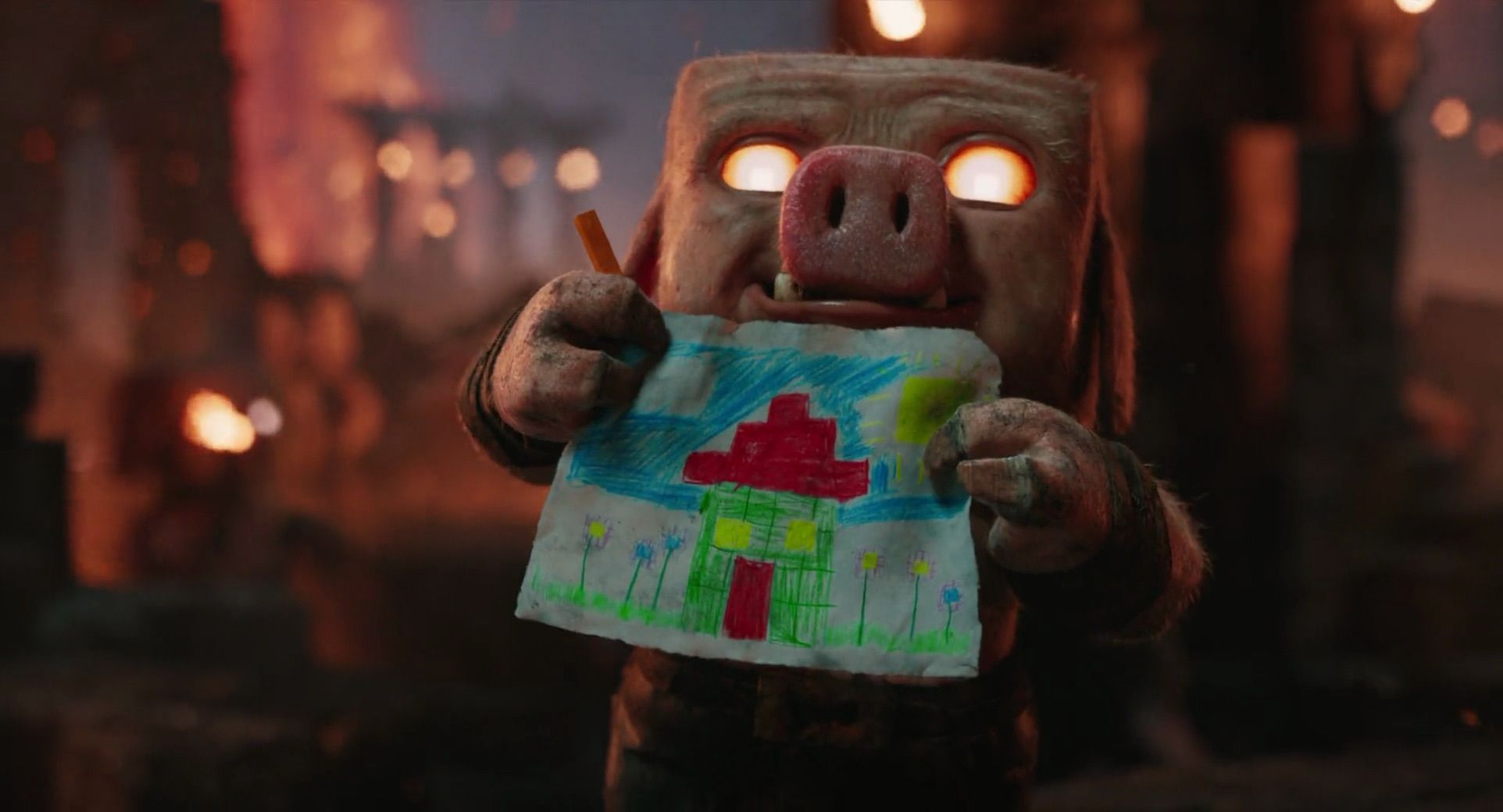
The film creates a world whose inhabitants have sentience and personalities, and it presents them as though they are unique individuals, then mistreats some of them as if they are disposable fodder for our heroes. The “piglins” are as much human as Steve or Garrett, even though they are largely enslaved by the evil Malgosha. But they aren’t treated as human.
Early in the film, Malgosha sees a child piglin hiding a scrap of parchment. She softens her voice and encourages the child to show it to her. “Come on,” she says, “I’m not going to bite you.” The child’s uncertain demeanor melts into pride as they force a grin, ultimately excited to display their drawing to someone showing genuine interest. Then, to demonstrate her evil nature, Malgosha asks the child how that will help her find gold, stabs them, which causes the child to burst-transform into a pork chop. “Oops,” she says, before tossing the dead meat behind her and moving on with the story.

I understand that she’s a bad person and the film is using this scene to convey as much. What unsettles me is not that Malgosha doesn’t care about the child, but that this scene gave me the impression that the filmmakers don’t think I should, either. There’s no dramatic music to punctuate action. The camera starts with the child front and center, presenting them as the audience’s focal point, and alternates between Malgosha’s perspective, over the shoulder as the child looks up at her. We start at the child’s height and, even though it switches to Malgosha, the majority of the scene plays out from the child’s perspective. In fact, we are at the same height as the piglin child when he is “oofed” out of existence. (Yes: I know “oof” is largely a Roblox term, not Minecraft, but I’m using it for the onomatopoeia since the kid poofs from piglin to pork chop.) Then Malgosha – the only remaining character within earshot – makes a joke, presumably to the audience (since no one is around), before shifting focus to a new discovery, progressing the plot.
This is one example, sure, but it left me slightly uncomfortable for the rest of the film. It’s not unusual for a story to have “disposable” enemies; see stormtroopers in Star Wars, henchmen in James Bond films, or the countless goombas given a painful treatment of instantaneous molecular compression. But they aren’t generally given faces, or if they are, don’t have names. And they are definitely never children expressing emotional vulnerability.
And while there are films where the audience is forced to attach themselves to a character only to have that character meet an untimely demise, those tend to be horror or thriller films and not a light-hearted adventure aimed at tweens and nostalgic Zennials.
“They’re total pacifists and vegetarians.”
The reason this moment exists is to demonstrate that Malgosha and her followers exist solely for the film’s protagonists to defeat. Even if they are capable of receiving the audience’s empathy, the filmmakers don’t think they deserve it. This mentality exists for the games, too, where all non-player characters serve the players’ experiences. We see this with the villager who escapes the Overworld and appears in Chuglass solely for a human (the ever delightful Jennifer Coolidge) to have as a personality-less, yet completely devoted romantic partner.
But the video game characters aren’t the only ones the film argues deserve no empathy: In A Minecraft Movie, this perspective extends beyond the Nether, even the Overworld, but to Chuglass, the “real world,” as well.
“You can’t call your party bags ‘Salt Sacks’.”
During art class, Henry draws a banana attached to a rocket-powered jetpack instead of drawing the same apple and banana as everyone else. The teacher says, “Do the assignment next time.” Then some bullies tell Henry that his jetpack would never work, he argues it would, then we get a montage of various science class equipment duct-taped together before ending up outside for a rocket demonstration. A bully stealthily clips a wire and the jetpack (which is attached to a model of a human skeleton) launches flawlessly before taking a sudden turn and targeting the giant potato (named “Chippy”) at a potato chip factory, which is the town’s biggest employer.
Based on that summary, one might assume the lesson behind that series of events is that, even if someone is talented, they should still discipline themselves to follow directions. Or maybe they shouldn’t do things because they are challenged by bad faith actors. But no: that would assume we are dealing with a typical group of people who all deserve the same amount of respect. The film doesn’t believe that. In fact, it spends a great deal of time during Henry and his sister’s story making jokes at the town and the townsfolk’s expense.
As we meet Henry and his sister, Natalie, we quickly learn their move to Chuglass was a choice made reluctantly; it was their mother’s dying wish. On top of that, Natalie was able to get a job as the potato chip company’s social media manager, which is demoralizing because her goal is to gain a measly 75 followers. When Henry starts school, the principal is shocked he enrolled since recent news stories announced their poor test scores. His art class is also taught by the gym teacher who rants about having a bad life and having to scrape money through various side hustles. Then, when the bullies mock Henry’s banana jetpack, one says, “I heard ‘math’ was debunked,” which further cements the students’ lack of intelligence.
Altogether, this paints the portrait of Chuglass as an undesirable place full of boring, complacent, stupid, unmotivated people, a depiction which clashes with the heroes who are creative, courageous, intelligent, and hard-working. As long as the heroes are doing well, then we shouldn’t care that the gym/art teacher is living in his car.
Which brings us back to the “moral” of the jetpack scene which is, given the rest of the context, “Life sucks, but learn to enjoy it anyway.” The characters don’t need to change anything about themselves except their tolerance for the stupid people around them. This mentality incentivizes people to accept suffering rather than attempt change, which is the exact same way certain people (once upon a time) convinced others to accept subservience, submission, and even (lest I say it?) bondage (and not the kind with “safe words”.)
The Minecrafter’s Burden
At the end of the film when Steve asks Henry if he’s sure he wants to return to Chuglass instead of staying in the Overworld, enticing him by pointing out how Chuglass has constraints, judgments, and obstacles, Henry says he’s going back anyway. Why? It’s not clear. Even in Jumanji: Welcome to the Jungle (another portal fantasy set in a video game world starring Jack Black), the main character struggles with whether or not he should go back. Because even if it’s a dangerous world full of unfamiliar settings and people, so is the real world.
But Jumanji 2 doesn’t treat the virtual world’s inhabitants as “other” in the same way as A Minecraft Movie, doesn’t treat the Overworld or the Nether as living worlds separate from ours. The Jumanji world exists as a place in which humans exist; in Minecraft – both the game and film – these are worlds for us to explore; to exploit; to dominate.
“I know how much you love bread.”
As the audience, though, we know why Henry wants to leave: the Overworld exists as wish fulfillment. It isn’t “real” in the same way as Chuglass. And even if Chuglass is full of stupid people and is an undesirable place to live, Henry can still make stuff, still “make the most of it.” The villagers aren’t “people” in the same way as humans, even the pathetic ones of Chuglass, so their community will never satisfy Henry in the same way as human companionship.
Even in the inter-credits scene, where Matt Berry voices the escaped villager, the idea that a human would treat a villager as an equal is the butt of the joke; the principal’s ex-husband (also the gym teacher) bursts into her office shocked and disgusted to find him replaced by the villager. The film exploits American English speakers’ linguistic stereotypes associated with traits of Berry’s speech to juxtapose the villager’s relative simplicity with British English’s air of civility and refinement. The joke only works if the audience already believes that some languages demonstrate higher levels of intelligence than others. Since the villagers don’t speak an actual language (nor creole or pidgin), the film isn’t even comparing two languages but a language with something inherently lesser.
I say the villagers in the Minecraft games don’t speak a language, even a constructed language, because the original sound designer considers their utterances “sound effects” and not “speech,” which makes them no different than the game’s hostile “mobs”, like zombies or creepers. Villagers are given as much humanity as the endless enemies players are expected to uncritically dispatch, even though they have agricultural communities with religious temples and a mercantile economic system. In this way, the relationship between the player and the villagers perfectly mirrors that of colonizer and indigenous groups.
Colonizer Mentality
Colonizers view the people inhabiting a land as obstacles preventing them from owning land, or assets to exploit, not a society of humans deserving respect. In order to rationalize their project, colonizers justify their actions by presuming that indigenous peoples aren’t worthy of the same respect, or that they aren’t even “people” in the same way as the colonizers.
Granted, there are some obvious differences. First of all, villagers did not launch with the game. The player was expected to exploit the land for years before villagers were added to the world. One could argue this makes the player similar to indigenous groups and the villagers are, in fact, the colonizers. But that would only make sense if the villagers were added with agency and self-determination.
Instead, they were preconceived as disposable player-aides, then added to the world. In this way, they exist as the literal embodiment of the colonizer’s vision; they aren’t simply a civilization of human beings deserving respect but obstacles or assets literally created for the player. In other words, the colonized exist to serve the colonizer.
Conclusion
To be clear, I doubt the filmmakers intended to make a film with this message. As a bit of a fan of the Hesses, I’ve watched Nacho Libre and Napoleon Dynamite with my family and I don’t think those films express the exact same worldview as what I argue above.
However, we can’t pretend that people’s assumptions don’t illustrate some of the “messed up” ways they view the world, even unintentionally. As an American, I am constantly told I live in the greatest country in the world, which is absolutely true if you’re wealthy, white, male, cisgendered, heterosexual, neurotypical, and (most importantly) living in America. Because as soon as you cross that border into one of those “shithole countries“, you switch from “human” to “villager”, from “player” to “piglin”. And then you’re just a disposable part of someone else’s story.
What do you think?